What is matcha, and why is it different from ordinary green tea?
Matcha and green tea come from the same plant. Two production steps — shading the plants before harvest, and grinding the leaf into powder — are what make matcha look, taste and behave differently in the cup.
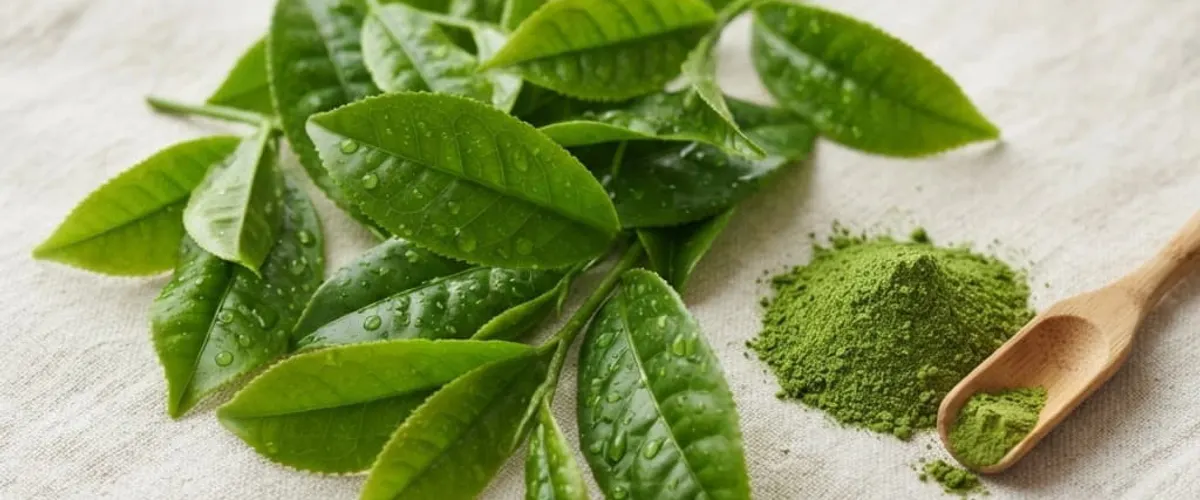
Shade-growing: why the colour is that green
For roughly three weeks before harvest, plants destined for matcha are covered so they receive far less direct light. The plant compensates by producing more chlorophyll, which is where the vivid green comes from, and by accumulating theanine, the amino acid behind the sweet, savoury note the Japanese call umami.
That is also why a dull or yellowish matcha is a warning sign: it usually means older powder or leaves that were not shade-grown to the same standard.
From leaf to powder
After harvest the leaves are steamed to stop oxidation, dried, then stripped of veins and stems. What remains is called tencha. Only then is it ground — traditionally on granite stone mills, slowly, because heat damages the aroma — into a powder fine enough to feel like talc.
The slowness matters commercially: a stone mill produces a modest amount of matcha per hour, which is a large part of why good matcha is expensive.
Why drinking the whole leaf changes everything
With a tea bag you extract part of the soluble compounds into water and discard the leaf. With matcha the leaf itself is suspended in the water and consumed. For the same weight of tea, that means more of everything the leaf contains — including caffeine.
It also explains the texture. Matcha does not dissolve like sugar; it stays in suspension, which is why it needs whisking and why it settles if you leave the cup standing.
Grades, and what the words on the tin mean
Ceremonial grade comes from the first harvest and young leaves, and is meant to be prepared with water alone. Culinary grade comes from later harvests, is coarser and more astringent, and is intended for lattes and baking, where other ingredients balance it.
Instant blends are a third category: matcha combined with other food ingredients so the powder disperses without a whisk. They are not competing with ceremonial grade on purity — they are competing on whether you actually drink it on a Tuesday morning.
None of these labels is regulated the way an appellation is, so treat them as a description of intent rather than a guarantee. Colour, aroma and price together tell you more than the word on the tin.
Where matcha comes from, and why origin is on the tin
Matcha production is concentrated in Japan, and the regions on the label are not decoration. Uji, south of Kyoto, is the historical centre and the reference point for the style most people picture when they say matcha. Nishio in Aichi produces a large share of the volume, Yame in Fukuoka and Kagoshima in the south are the other names you will see.
Matcha is also grown outside Japan — in China, Korea and increasingly elsewhere — and that is not automatically a defect. What changes is the processing tradition: shading duration, steaming rather than pan-firing, de-veining, and whether it was stone-milled or ball-milled. Ball milling is faster and cheaper and generates more heat, which costs aroma.
A practical shortcut when a label tells you nothing: colour and price together are more informative than the words. Bright jade for a low price is unusual; dull olive for a high price is a bad trade.
How to tell decent matcha from tired matcha
Colour. Vivid, almost fluorescent green means chlorophyll intact. Olive, brown-tinged or khaki means old powder, unshaded leaf, or heat damage during milling.
Texture. Good matcha feels like talcum powder and clings to the side of a spoon. Grittiness means a coarse grind, which will also taste harsher.
Smell. Fresh matcha smells sweet and vegetal, a little like fresh-cut grass with a marine note. A flat or hay-like smell is a powder that has been open too long.
Behaviour in water. Fine matcha suspends and foams. If it sinks in clumps regardless of technique, the grind is the problem, not you.
Questions
Is matcha stronger than green tea?
In concentration, yes — you consume the whole leaf instead of an infusion, so a gram of matcha delivers more of the leaf’s compounds, caffeine included. Whether a cup is "stronger" depends on how much powder you use.
Does matcha go off?
It does not spoil in a dangerous way, but it degrades. Exposed to air, light and heat it loses colour and aroma within weeks. Keep the container closed, away from the hob and the window.
Why is good matcha expensive?
Shading, hand-picking the youngest leaves, de-veining and slow stone grinding are all labour- and time-intensive. A stone mill produces a small amount per hour, and that cost carries into the price.